Play · Growth · Human Flourishing·Powered by AI
Moses Silbiger, MA
Researcher - AI · Interactive Entertainment · Developmental Psychology

THE ORIGINAL RESEARCH

THE ORIGINAL RESEARCH

Press Play to Grow!
Early Years: 2008-2010 (Then & Now)
What was asked, what was found,
and why it still matters

A Question Nobody Was Asking
The research that started before anyone knew to ask
"I certainly wouldn't discourage it. Those kinds of things are certainly possible."
- Philosopher and author Ken Wilber, in conversation with Moses Silbiger, Integral Life, 2008
Every significant initiative has a moment of origin. For Press Play to Grow!, it was a question that arrived while reading at the intersection
of developmental psychology and interactive entertainment in 2007:
What if interactive entertainment could serve as a Conveyor Belt for human development - not just for a few, but for millions of people who
would never seek out a psychology book, a coaching program, or a spiritual practice?
That question became an eight-month mixed-methods research project, completed as a Master's thesis in Integral Psychology at
John F. Kennedy University in San Francisco in 2008, in a class taught by Sean Esbjörn-Hargens.
Two years later it was published by SUNY Press in the Journal of Integral Theory and Practice, in a special issue on Integral Research
guest-edited by Nicholas Hedlund.
This was not a think piece. It was a peer-reviewed research study - possibly the first multi-method, cross-disciplinary academic investigation
into the convergence of interactive entertainment and developmental psychology.
And it was pointing at something that, at the time, almost no one else in either field was looking at.

Where the Research Came From
A personal story at the intersection of three worlds
The research didn't begin in a library. It began at the intersection of three worlds that had been running in parallel for years: architecture
and 3D visualization, personal and spiritual development, and a lifelong relationship with technology and interactive media.
Video games were chosen as the subject deliberately - not because they were the obvious choice, but because they were the most effective
interactive medium available for reaching people where they already were. As Moses Silbiger noted at the time:
"My whole research is looking at the future - researching how video games are today to look at the potential that they can be used for tomorrow.
That future-oriented lens is what made the research ahead of its time. And it is what makes it more relevant today than when it was published.


What Was Done: The Methodology
A rigorous multi-method investigation across six research zones
The research used Integral Methodological Pluralism - a comprehensive approach that investigates a phenomenon from multiple perspectives
simultaneously, employing six of the eight available research zones.
Phenomenological exploration
Firsthand immersive play across multiple game genres, including a 40-hour research marathon playing Bioshock -
chosen for its unusual moral complexity and narrative depth - as well as World of Warcraft, Portal, Second Life, Guitar Hero, Wii Sports, and over
a dozen others. Each was analyzed through a developmental framework for what dimensions of human growth they touched, how, and how deliberately.
Structural analysis
Self-assessment through the Enneagram, Myers-Briggs, and Susanne Cook-Greuter's Sentence Completion Test, establishing
the researcher's own developmental profile and how it shaped the inquiry itself.
Hermeneutical Analysis
Including five full days as a participant-observer at the Game Developers Conference 2008
in San Francisco - one of the largest gatherings of game industry professionals in the world. This immersion provided direct access to what the industry
was actually thinking and building at that moment, including early discussions of emotional AI, the "uncanny valley" in character design, and the
emergence of serious games.
It also included in-depth conversations with leading figures at the intersection of technology, interactive entertainment, and developmental thinking -
including Daniel Erickson, lead narrative designer at BioWare, one of the most sophisticated game studios in the world at the time.
Ethnomethodological Analysis
In-depth conversations with leading figures at the intersection of technology, interactive entertainment, and developmental thinking -
including Ken WIlber - philosopher, best-selling author, and founder of Integral Theory - and Daniel Erickson - lead narrative designer at BioWare,
one of the most sophisticated game studios in the world at the time.
Empirical survey
A comparative analysis of 150 participants across three distinct groups: people engaged in personal and spiritual growth, people working
in or around video games and game design, and people with genuine interest in both.
Systems analysis
A broad examination of the educational, cultural, economic, and technological systems surrounding interactive entertainment at that historical moment.

The GDC Conversation - and a Broader Intellectual Context
When the industry's leading conference meets the era's leading thinkers
The five days at GDC 2008 produced one of the most striking observations of the entire research: game designers themselves, in their own words,
were describing an industry moving from what they called a more juvenile center of gravity toward something more mature.
They were talking about social responsibility, emotional depth, conflict resolution without violence, and the desire to bring the lessons of games
into the real world.
This observation was later shared in a conversation with one of the era's most prominent thinkers at the intersection of consciousness and technology.
That conversation, recorded and published on Integral Life in September 2008, sits on the same page as interviews with Kevin Kelly - co-founder of Wired magazine - Michael Crichton, author of Jurassic Park, and Rupert Sheldrake, the biologist behind the theory of morphic resonance.It is not incidental that this thinker - philosopher and author Ken Wilber - was also chosen by the Wachowski Brothers, alongside Princeton philosopher
Cornel West, to provide the philosophical commentary for the Ultimate Matrix Collection, the collector's edition of the Matrix trilogy.
The Wachowskis made a film about simulated reality, the nature of consciousness, and human awakening inside a technological system -
and chose these two thinkers to frame its meaning. That context matters here, because the questions the research was asking in 2008 were not far
from the questions the Matrix itself was asking.
In that conversation, Wilber confirmed that he had been thinking about using video games for human development for nearly twenty years - and that the research had brought a dormant idea back to life. He described a specific game design vision: a player signs in, takes a questionnaire that identifies their developmental center of gravity, and the game then tilts the playing field - rewarding responses above that center of gravity, challenging responses below it.
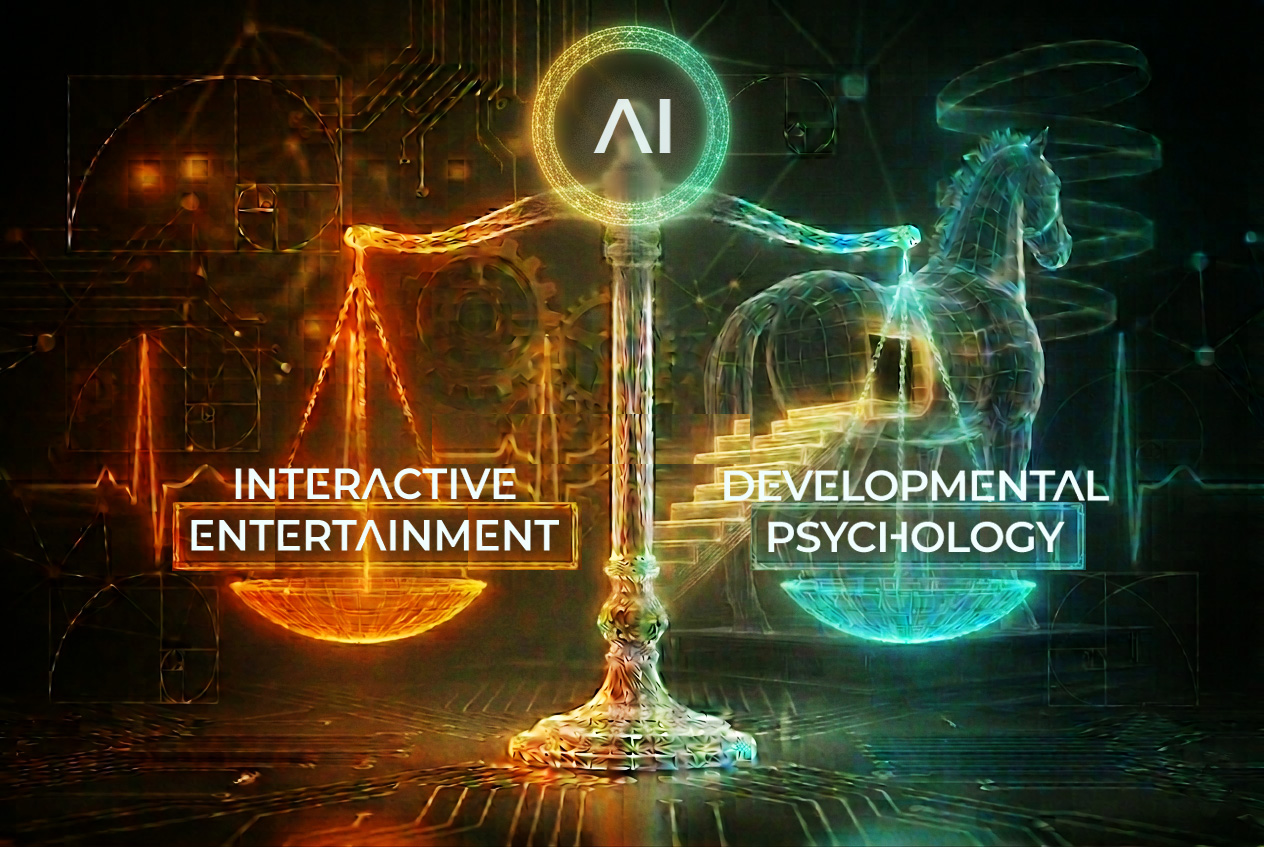
Invisible developmental design, embedded inside an engaging experience. The Trojan Horse, described in his own words.
He also named the hardest design challenge of all: the self-related lines of development - values, identity, meaning-making - involve not just learning
but what he called a kind of death and rebirth. A disidentification with who you currently are and a rebirth into the next level.
That, he said, is even harder to engineer. But not impossible. And worth attempting.

What the Research Found
Survey data, qualitative insights, and what the industry revealed about itself

From the survey:
The 150 participants across three groups painted a revealing picture.
Most had experienced some form of growth while playing games - though they described it differently depending on their background.The game-world group tended to cite cognitive and problem-solving growth.The personal growth group cited physical and coordination benefits.The cross-group - those with a foot in both worlds - described the broadest range: social skills, emotional intelligence, ethical reasoning,
interpersonal awareness, and insights about identity and values.
When asked whether they would be willing to play games designed intentionally for personal growth, the majority across all groups said
yes - sometimes or very often.This was not a niche interest. It was a latent, largely unmet demand waiting for the right design response.
From the Qualitative Research:
The qualitative findings were equally striking. Participants who engaged most deeply with games described experiences that went beyond entertainment -
altered states of absorption, moral dilemmas that transferred to real-life reflection, social bonds formed through collaborative challenges, and a sense of agency and growth that conventional media could not produce.The games generating the most cultural resonance in 2007-2008 - Bioshock, Mass Effect, Portal, World of Warcraft - were precisely the ones accidentally
touching developmental territory. Not by design. By accident, intuition, and the instinct of talented creators working without a developmental map.
The research named this pattern and proposed what it would look like to make it intentional.
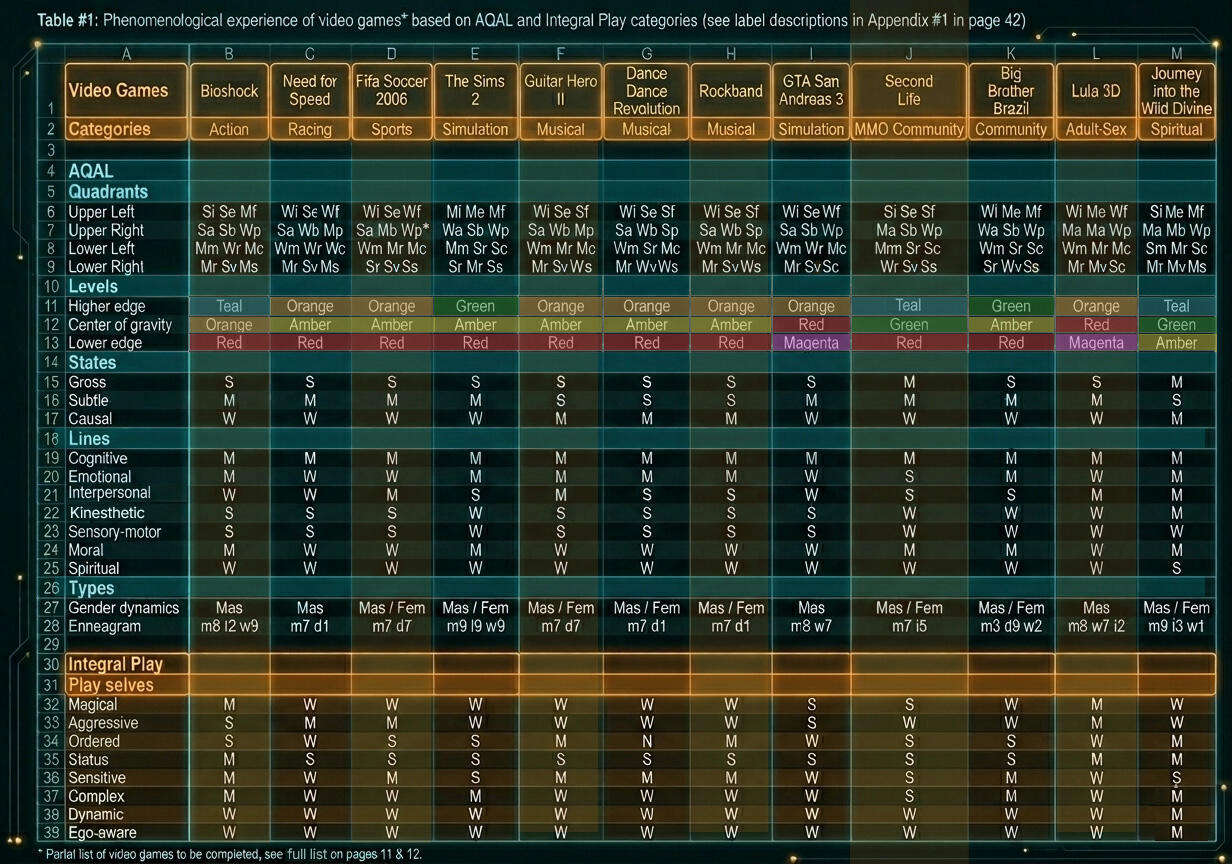
Preview of AQAL's
self-assessment table
across 12+ video games
(JITP, SUNY PRESS, 2010)
Full scale, legend &
methodology guide
on Research-Evidence page
From the GDC 2008 immersion:
Five days inside the game industry's largest annual gathering confirmed what the survey data suggested. The industry was reaching toward something it couldn't fully name - more meaningful, more emotionally sophisticated, more socially responsible.Green values entering orange territory. The beginning of a shift that, in developmental terms, was predictable and healthy -
but still far short of what a comprehensive developmental framework would make possible.

The Framework: INDENTRO
The Seed of AiPLAYVOLVE!
One word. Five layers. Two languages. One vision - 17 years before its time.



INDENTRO · Video Game Design Framework·2008
INtegral · DEvelopmetal TROjan Horse Framework
INtegral + DENTRO · within (in Portuguese)

The research produced a concrete design framework: INDENTRO - the Integral-Developmental Trojan Horse approach.
The name itself was a multilayered construction - a deliberate play on words across two languages and five concepts:
IN - go within, in English. Because real development requires going inward.
DENTRO - within, in Portuguese, the researcher's native language. The same invitation, in the language he thinks in.INtegral** - the theoretical framework.
DEvelopmeNtal** - the purpose behind every design decision.
TROjan Horse** - the philosophy: growth invisible inside play.
One word. Five layers. Two languages. One vision.
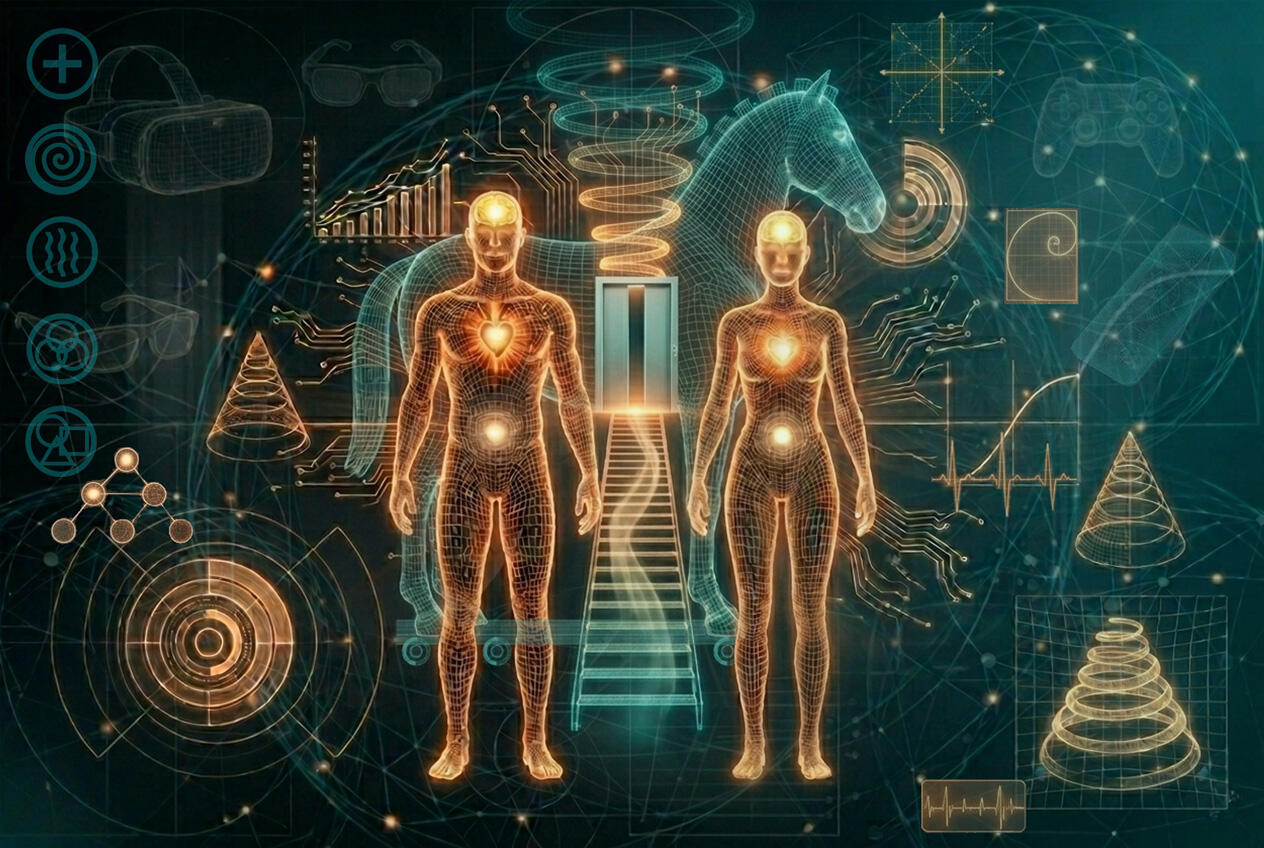
INDENTRO proposed that a new category of interactive experience could be designed to address all five elements of a comprehensive developmental framework simultaneously - Quadrants, Levels, Lines, States & Types - invisibly embedded within an experience that is genuinely entertaining and freely chosen.
Not a serious game. Not educational software. Not a regular coaching or therapeutic tool.
A real experience - one that respects the intelligence of the player, honors the craft of great game design, and also knows something about
human development that most game designers don't.
Seventeen years later, that same vision has a new name.
One that reflects not just the philosophy but the technology that finally makes it fully realizable: AiPLAYVOLVE!

Ai - the engine, with a nod to the iPhone generation of consumer technology that made powerful tools feel personal and natural.
The lowercase i is intentional - a quiet reference to that design philosophy, with the full AI visible as a subtle presence behind it.
Play - the vehicle, the joy, the medium.
volve - evolve.
The hidden e from evolve - silent, invisible, present in the original word but dropped in the name - is the 'Trojan Horse' of the name itself.
INDENTRO pointed inward. AiPlayvolve points forward.
Same vision. New era. Finally buildable.

Why It Was Ahead of Its Time
The vision was clear. The technology wasn't ready. Yet.
In 2008, realizing the full vision of what the research proposed would have required capabilities that simply didn't exist.
The technology to read emotional states in real time, to adapt experiences to individual developmental profiles, to generate responsive narrative on the fly -
none of it was available at the scale or sophistication the vision required.
What existed was the framework. And a clear anticipation of where the technology would need to go.
The research explicitly named AI, virtual technology, and brain-mind interfaces as the necessary innovations that would need to mature before the vision
could be fully realized. It framed itself as "one of the first conscious steps in an overall evolutionary trend" - not a finished product, but a direction.
That direction has now been confirmed by nearly two decades of technological development that the research anticipated but could not yet build.

What Has Changed - and What Hasn't
Three fields transformed. One gap remaining.
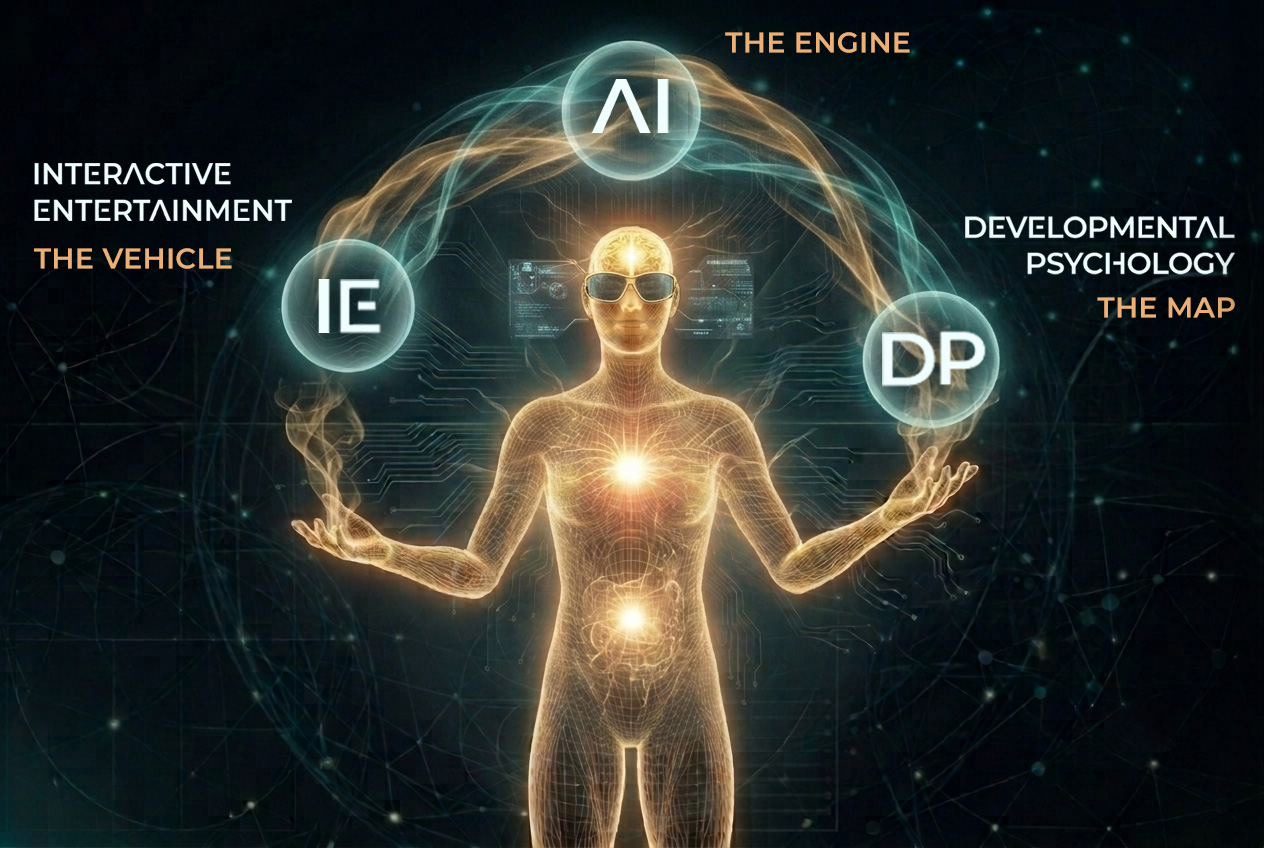
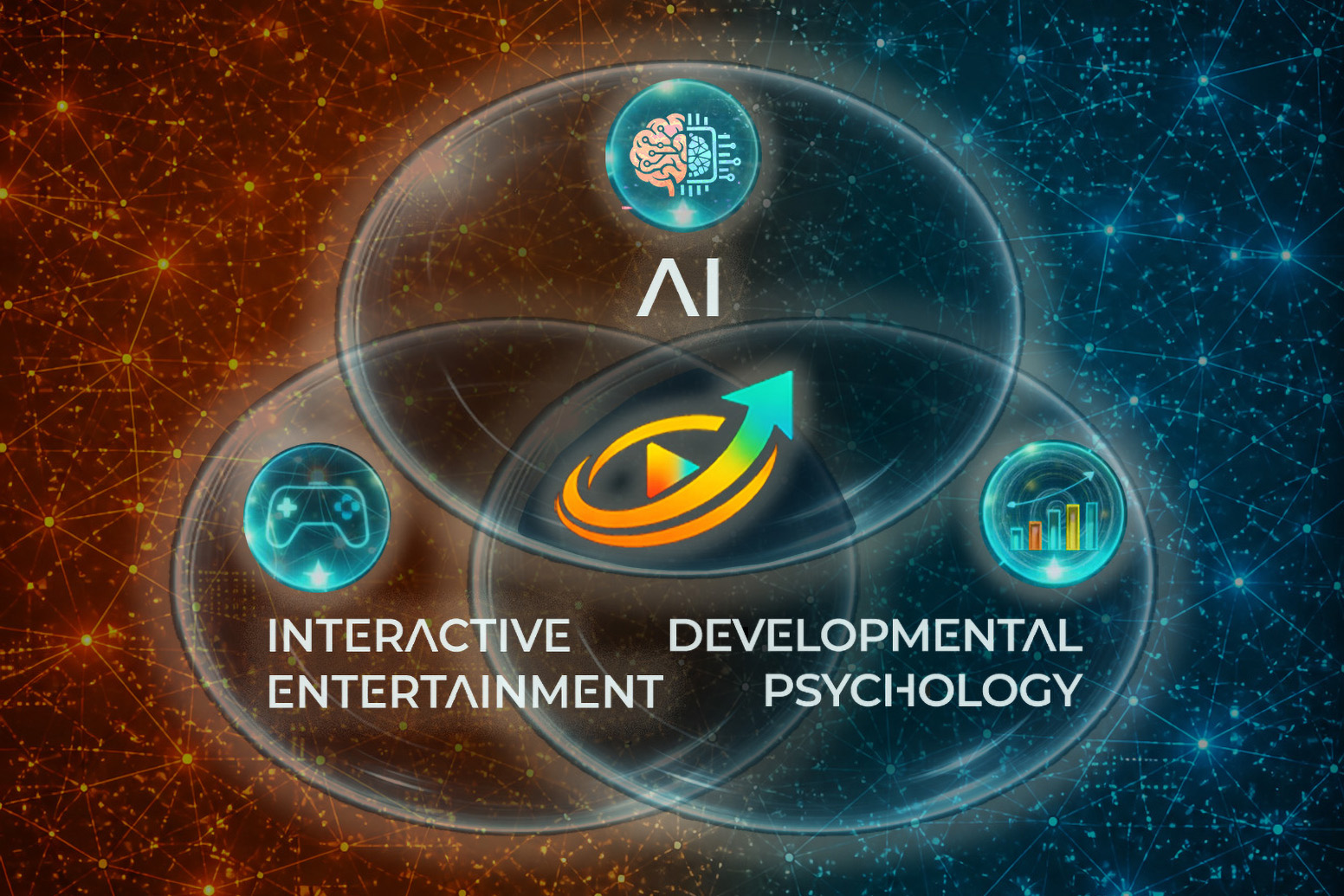
The three fields that PPG identified in 2008 have each undergone profound transformation in the years since.
Interactive Entertainment has become a globally dominant medium with a growing body of evidence for its impact on wellbeing, empathy, and behavior.AI has moved from invisible game logic to an explicit, extraordinarily capable force that can read emotional states in real time, adapt experiences individually,
and serve as a personalized developmental guide.Developmental Psychology has gained institutional traction - vertical development is now recognized in leadership, coaching, and organizational contexts
in ways it wasn't in 2010.
What hasn't changed is the gap. The framework that PPG proposed - a comprehensive, integrative approach that addresses the whole person across all developmental dimensions simultaneously, using interactive entertainment as the vehicle - still doesn't exist anywhere in the field.
The engine exists. The medium exists. The map exists.What was a vision in 2008 is now an engineering problem in 2026.In 2026, for the first time, all three are ready at the same time.The research didn't just anticipate this moment.It mapped the territory this moment is now ready to build in.

An Invitation
The question was asked in 2008. The conditions to answer it arrived in 2026.
The pages that follow explore each of the three pillars of Press Play to Grow! in depth - where each field stands today, what it has developed,
what it is still missing, and what becomes possible when all three converge.
The original research asked the question. The convergence of 2026 provides the conditions to answer it.

Site Architecture
Home



Gateway Pages








Research Trajectory · Deep Dive








Communication · Many Channels








contact
On the same wavelength?
If this research resonates with you - whether you work in AI, Interactive Entertainment,
or Developmental Psychology, or simply want to connect as a kindred spirit - let's talk.


THE ORIGINAL RESEARCH

© 2026 Press Play to Grow! All rights reserved.